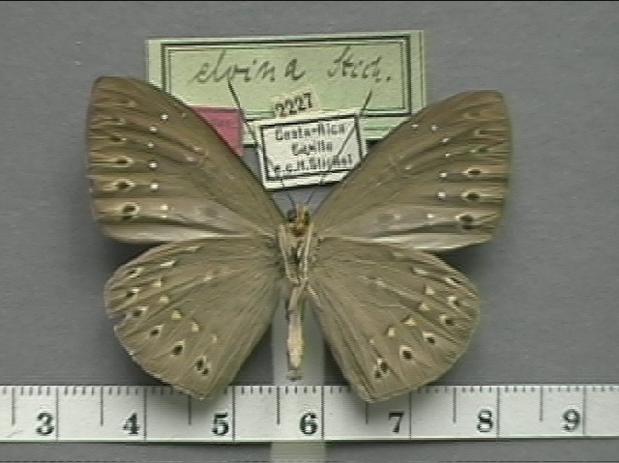
Dardus Clade: Eurybia jemima
This group is comprised of theee nominal species whose distributions are all restricted to eastern Brazil. E.
Forewing: 25-29mm
Proboscis: 34-39mm
Range: Ecuador
This species has a much more lively expression of orange along the wing margin, especially the forewing, than other species in this clade. It is distinguished from other members of this clade on the basis of male genitalia: The dorsal margin of the cucullus has conspicuous knobs in this species, while the margin is relatively smooth in other members of the clade.
(Hanner 1997)
Dardus Clade: Eurybia jemima
Forewing: 21-27mm
Proboscis: 28-32mm
Range: Colombia, Ecuador and Peru
Dardus Clade: Eurybia latifasciata
Forewing: 21-25mm
Proboscis: 27-34mm
Range: French Fuiana, eastern Colombia, Ecuador, Peru and northwest Brazil
Males of this species possess a sclerotized transtilla, differentiating them from dardus. On the basis of this trait, Stichel’s (1910) dardus annulata is formally sunk under this heading. Unlike dardus, franciscana has a transtilla with setae in tufts, rather than dispersed setae.
(Hanner 1997)
Dardus Clade: Eurybia franciscana
Forewing: 19-23mm
Proboscis: 22-26mm
Range: Central America and western Colombia
This species can be distinguished from the other members of the clade by the presence of a 45⁰ bend in the aedeagus near its connection with the juxta, while in the other species the aedeagus is basically straight. Furthermore, the sacculus of this species is arched dorsoventrally, while in other members of this clade it extends straight.
(Hanner 1997)
Dardus Clade: Eurybia unixa
Forewing: 21-25mm
Proboscis: 28-38mm
Range: Ecuador, Peru, Brazil and Bolivia
The males of this species lack a sclerotized transtilla, a trait which separates the various incarnations of dardus from other members of this clade.
(Hanner 1997)
Dardus Clade: Eurybia dardus
Range: Para, Brazil.
This previously described form of halimede is here elevated (from infrasubspecies) to full species status based on morphological identity. Degree of expression of iridescence is highly variable even at a given site. The best way to identify this species is on the basis of male genitalia. This species has a unique combination of male genitalic characters, separating it from other members of this clade: a well-developed sacculus that is flattened in cross section and longer than the cucullus.
(Hanner 1997)
Halimede Clade: Eurybia violaria
Forewing: 23-26mm
Proboscis: 39-46mm
Range: Colombia, Ecuador, Peru, Brazil and Bolivia
This broadly distributed species occurs in a variety of sizes and wing-colour pattern morphs both within and among collection locales. Two previously recognized subspecies are sunk under this species name. It is the only member of the clade where the male ventral surface of the uncus forms a rounded arch as opposed to a peak. Also in cross section, the base of the cucullus is round and elongate, unlike other members of this clade.
Halimede Clade: Eurybia halimede
Forewing: 24-26mm
Proboscis: 38-43mm
Range: Rhondonia to Mato Gross, Brazil and Bolivia
This former subspecies of elvina is elevated to full species status. This species is the only member of the clade with the base fo the sacculus not swollen. Males are also discerned on the basis of a unique combination of characters; the sacculus is flattened in cross section and shorter than the cucullus.
(Hanner 1997)
Halimede Clade: Eurybia tephrias